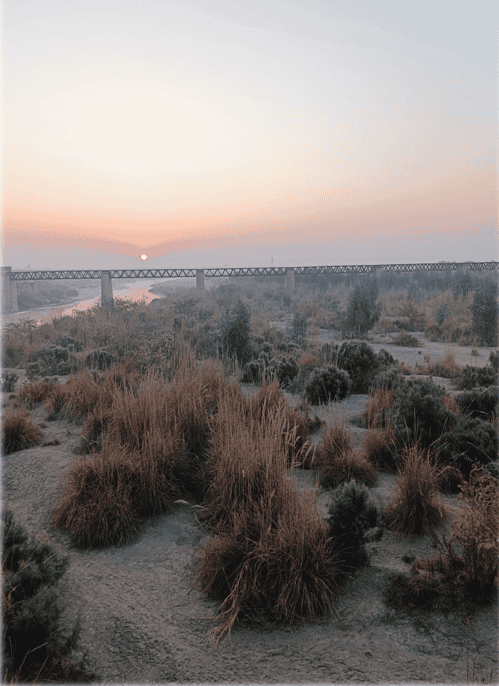
I belong to Bannu, which is a small town located on the banks of the River Kurram in the south of Khyber Pakhtunkhwa province of Pakistan. In my mother tongue, Pashto, Baani Kair means the house of Bannu. I have given this name to Part II because I consider myself a citizen of the world and feel the whole world to be my home. Therefore, I am as much sincere with the world as I am with my home.
So as to appreciate the beauty of a landscape, the most important thing is to get a holistic view. Only then can one feel the splendor which trickles down from the heavens right up to minuscule ruddy flowers. This is why people go to mountain peaks and enjoy a bird’s-eye view of the valleys underneath.
Similarly, so as to better understand an ideological landscape, the most important thing is to get a holistic view. Say, there is a certain billionaire who is diabetic and due to this medical predicament both his lower limbs have been amputated. If someone informs us that the billionaire has a lot of money but does not mention that his limbs have been amputated on medical grounds then we would miss out on a very important detail. In a nutshell, the ideological picture of the person would be incomplete.
Nations are but magnified images of individuals. Current classification criteria judge them on the basis of either geography or ideology or economy; thus, giving an incomplete picture. A list which tells us that a certain country is area-wise big or small or its GDP is more or less gives incomplete information about its well-being. Baani Kair classification intertwines geography, ideology and economy of countries in a way that a holistic picture of well-being of a country emerges by having a look at a single table.
Baani Kair provides neutral and holistic criteria for classification of countries. Without this knowledge we do not know who is who and what is what.